
Explore the everyday challenges repair businesses face and how repair management software can simplify jobs, communication, records, and follow-ups.
If you own a repair shop, how much of your day is spent fixing items and how much is spent looking for information, tracking down updates, and answering the same questions twice? For many repair businesses, the truth is that a significant portion of the day is spent on administration rather than repair work.
This article examines the day-to-day operational problems that repair businesses encounter, such as job monitoring and staff coordination, as well as client communication management and follow-up. It also explains why we created ManageMyRepair, a repair management tool tailored to address these specific issues.
Key Takeaways
Repair businesses generally utilize many technologies to manage customer inquiries, appointments, estimates, job statuses, parts, and follow-ups.
Inconsistent job information and statuses might lead to uncertainty about progress, ownership, and future steps.
Inconsistent customer updates are a major source of dissatisfaction for both consumers and employees.
Missed follow-ups on estimates, delayed parts, or completed repairs can impact client trust and repeat business.
ManageMyRepair organizes everyday duties.
Why Repair Management Can Be Difficult
Running a repair business requires significantly more coordination than just the repair. Behind every completed project lies a series of smaller tasks that must be completed in the proper order, at the correct time, and by the appropriate person. On any given day, a team may handle:
New customer requests via phone, email, walk-in, or online form.
Scheduling, confirming, and rearranging appointments.
Provide repair specifics, such as the reported issue, diagnostic notes, and completed work.
Customers must evaluate estimates and approvals before work may proceed.
Assign technicians or staff to the appropriate jobs at the proper time.
Check, order, or confirm availability of parts or materials.
Provide accurate job status updates, not just the last known location for the repair.
Provide invoices and compensation for completed services.
Provide follow-ups before, during, and after repairs, including pickup or delivery.
Each of these elements interacts with the others. A delay in sections influences the estimation. A missed status update undermines customer trust. A staff member who is unsure of their assignment can slow down the entire process. This is what makes repair service management so difficult, not any single operation on its own, but the sheer number of moving elements that must all remain connected.
When there is no single, coordinated way to perceive the big picture of a work, minor gaps tend to compound. A missing note here, an unclear status there, and soon employees are spending time recreating information that should have been simple to find in the first place.
Challenge 1: Tracking Every Repair Job
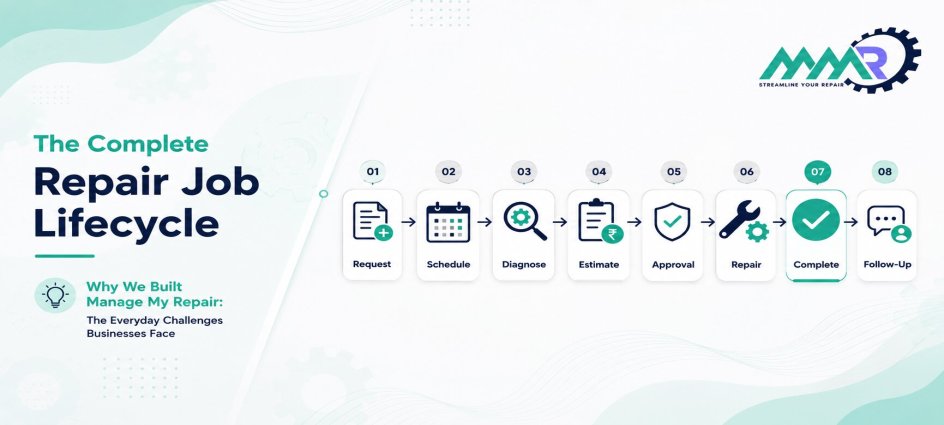
A repair job often goes through several distinct stages: request, review, scheduling, diagnosis, estimate, approval, work on, and completion. At each stage, someone must be aware of what has occurred thus far and what must occur next. This is the foundation of repair task monitoring, and it seems straightforward in theory.
In practice, difficulties arise when this information is not tracked regularly. Notes are left on paper tickets, texted to a coworker, or just remembered rather than being saved anywhere searchable. Job statuses may be updated inconsistently, making it unclear if a repair is "in progress," "waiting for approval," "waiting on parts," or "ready for pickup." Without clear ownership of each stage, it is typical for a task to be unfinished simply because no one was sure whose turn it was to carry it ahead.
This type of gap is rarely caused by negligence. It stems from relying on recollection and informal communication to track something that requires a more systematic approach, especially when job volume increases and more people get involved.
Hypothetical example: Consider a repair shop where a technician diagnoses an issue and verbally informs the front desk that the estimate is ready. If that information is not recorded somewhere formal, the front desk may not follow up with the customer, and the job may go unnoticed until someone inquiries about its days later. This is a fictional situation intended to demonstrate a common type of gap in repair job pipeline visibility, not an account of a real firm.
Challenge 2: Managing Customer Communication
Customers typically want to know a few basic things: Was my request received? When's my appointment? How is the repair progressing? Is there anything that is delayed? Do you need my approval for something? When will it be ready?
These questions appear simple, but addressing them consistently for every customer, on every task is where many repair shops stumble. When updates are intermittent, users are left to check in on their own, calling or messaging to ask, "Any update?" This adds extra labor for employees, who must now stop what they're doing, search up the job, and respond, frequently to a question that should have been answered proactively.
Inconsistent communication can impact on how customers see the company over time, even if the repair work is performed effectively. A customer who needs to pursue updates may form a different opinion than one who receives fast, clear repair service customer updates without having to ask. This is part of what makes customer communication for repair businesses appear tidy or disorganized from the outside, regardless of how much work is done behind the scenes.
Consistent communication also minimizes the number of interruptions that staff receive throughout the day, since consumers are less likely to call in for status updates when they know what to expect.
Challenge 3: Keeping Repair Information Organized
Every repair work produces a growing amount of data: customer contact information, a description of the problem, diagnostic notes, photographs, the estimate, approval status, and a record of what was done. Keeping information structured is critical, both for the present job and for future repairs involving the same customer or equipment.
The difficulty is that this information is frequently spread across multiple locations. A customer's initial inquiry may arrive via email. Notes from the diagnostic may be scrawled on a ticket. Photos might be stored on a technician's personal phone. The estimate may be on a spreadsheet, and approval could come via text message, which is easily lost in a lengthier chat thread. When repairing customer records are scattered over phone calls, email threads, paper notes, messaging applications, and spreadsheets, assembling a complete picture of a single task might take much longer than necessary.
This dispersal also makes it more difficult to look back at repair history when it is needed for warranty problems, a returning customer looking to reference a previous repair, or simply to learn patterns in the type of work a company handles most frequently. Good business repair administration is based on being able to access the relevant information quickly, not remembering where it was initially saved.
Challenge 4: Reducing Missed Follow-Ups
Follow-ups are an expected aspect of repair work, but they are also simple to overlook if they are not documented somewhere dependable. Common follow-ups include the following:
Confirming an upcoming appointment
Following up on an estimate that hasn't been approved yet
Checking in on delayed parts
Sending a repair-status update
Notifying a customer that an item is ready for collection or delivery
Following up after the repair to confirm everything is working as expected
Missed customer follow-ups are common, not because employees don't care, but because there is no consistent method for tracking who needs to do what and when. When follow-ups exist solely in someone's memory or on a mental to-do list, they are prone to being lost when that person becomes preoccupied with something else, which happens frequently in the repair industry.
A simple, repeatable follow-up process can help close this gap without requiring anything complicated:
Record the follow-up as soon as it's identified, rather than trusting it to memory.
Assign it to a specific person, not just "whoever has time."
Add a due date so it doesn't get pushed indefinitely.
Record the result once the follow-up happens, so there's a clear record of what was communicated.
Schedule the next action, if one is needed, so the job keeps moving forward.
This type of process does not require software to begin; a shared checklist or basic log can suffice. However, maintaining this consistency across all jobs and staff members becomes more difficult as a corporation grows, and manual tools alone begin to show their limitations.
Challenge 5: Balancing Administration with Repair Work
Repair technicians are often trained and motivated to perform repairs rather than paperwork. However, manual data input, answering repeated "what's the status?" questions, tracking job progress across many tools, and coordinating among staff members all need significant time and attention throughout the day.
This is not a claim about how long these jobs take in every organization; it varies greatly depending on team size, work volume, and existing processes, and we do not have accurate numbers to offer here. Simply said, this type of administrative job competes for the same hours as the repair and customer service that the company exists to deliver. Every minute spent looking for a missed note or reading a status update aloud is time not spent on the bench or with a customer in front of you.
Finding a better balance between hands-on repair work and administrative assistance is an issue that many repair firms face, regardless of size, specialty, or length of time in company.
What We Built with Manage My Repair
We created Manage My Repair because the issues stated above are widespread in many types of repair businesses, and we feel there is a true need for a more organized approach to handle them without adding excessive complexity to an already hectic day.
Manage My Repair is designed around the following areas:
Scheduling appointments and time slots across staff and locations, with clear availability immediately
Managing repairs from request to completion, so nothing gets lost between stages
Tracking repair status in a simple, consistent way that's easy to check at any point
Keeping customer and repair records together in one connected place
Recording communication tied directly to each repair
Managing follow-ups like assignment, due dates, and outcomes
Tracking estimates and approvals as part of the repair record
We designed this with genuine repair-business operations in mind, and feedback from repair businesses continues to influence how the product improves as more teams use it.
Who Manage My Repair Is For
Managemyrepair was created for repair firms looking for a more structured approach to managing projects, clients, and communication. This could include owners who want more visibility into what's going on throughout the company, managers who coordinate staff schedules and workloads, administrators who handle customer requests and records on a daily basis, or employees who require clear, reliable information to do their jobs well without having to track someone down for an answer.
Our approach is wide rather than narrowly focused on one sort of repair work, because the issues stated above monitoring projects, managing communication, staying organized, and avoiding missed follow-ups are common across many types of repair firms, not just one industry.
Frequently Asked Questions
What are the common challenges repair businesses face?
Repair businesses commonly deal with disorganized job information, inconsistent client updates, information spread across several platforms, missed follow-ups, and the continual balancing of administrative and hands-on repair tasks. As job demand rises, these concerns become more apparent.
How can a repair business improve job tracking?
Improving project tracking often starts with recording clear, consistent statuses for each repair, assigning explicit responsibilities for each step, and keeping notes in one conveniently accessible spot rather than scattered across paper, memory, or various interactions among staffs.
How can repair businesses improve customer communication?
Customers benefit from proactive notifications at critical stages such as receiving a request, confirming an appointment, experiencing a delay, or completing a repair. Clients value consistency above frequency; they want to know what to anticipate and when to expect it.
How can repair businesses reduce missed follow-ups?
A simple follow-up strategy is beneficial: record the follow-up, assign it to someone, set a deadline, document the outcome, and plan the next step if necessary. Writing this down on a frequent basis, rather than depending solely on memory, considerably reduces the possibility that something will slip through.
When should a repair business move beyond spreadsheets?
There is no single trigger point, but common symptoms include difficulty getting job information quickly, frequent missed follow-ups, and spending significantly more time on administration as job volume increases. At that time, it may be worth investigating more organized, purpose-built repair-management software.
What should repair businesses look for in repair-management software?
Clear task status tracking, a central area for client information and communication, easy scheduling, and a reliable means of handling follow-ups are all typically beneficial characteristics. The right match is also decided by how a specific firm runs daily.
Is Manage My Repair available now?
Yes, Manage My Repair is now available. You may also Schedule a free demo to see it in action and determine whether it is a good fit for your repair business before committing.
Final Thoughts
Repair businesses must manage numerous tasks, including incoming requests, appointments, estimates, parts, staff coordination, and client expectations, all while keeping the actual repair job moving forward. Scattered information, irregular updates, and missed follow-ups are common friction spots not because organizations are incapable, but because manual tools were not designed to keep all of this together as operations scale.
That's the problem space Manage My Repair was designed to solve. We designed it to address the common difficulties that repair businesses experience, with the purpose of assisting teams in staying organized without adding unnecessary complexity to their day.
Manage My Repair is available now. If you manage a repair business, tell us which tasks take the most time or which problems you'd most like to solve. Contact us to share your feedback, or Book a Free Demo to see whether it fits the way your team works.
Disclaimer: This article is intended for general informational purposes and reflects Manage My Repair's approach to common repair-business challenges. It is not business, legal, or operational advice, and any examples described as hypothetical are illustrative only.
 Previous Blog
How to Reduce Repair Turnaround Time and Improve Efficiency
Next Blog
Why Repair Shops Lose Customers After the First Inquiry
Previous Blog
How to Reduce Repair Turnaround Time and Improve Efficiency
Next Blog
Why Repair Shops Lose Customers After the First Inquiry


0 Comments on “Why We Built Manage My Repair: The Everyday Challenges Businesses Face”